
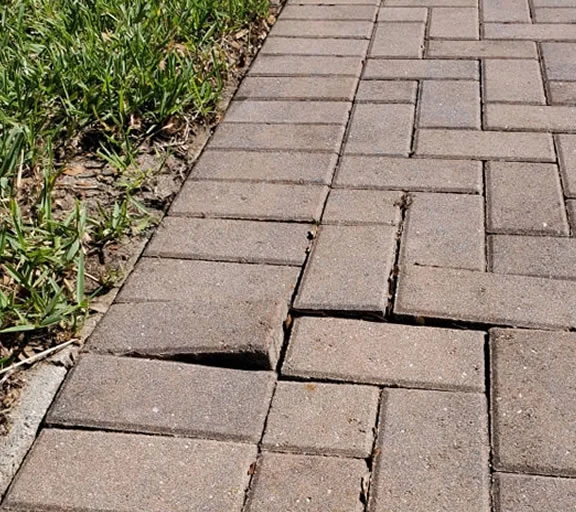
The most useful answer begins with the condition at the property. Materials, age, base, drainage and previous work can change what is practical, so this article is a starting point—not a diagnosis from a photograph.
The surface follows the base
Interlocking pavers rely on a prepared base and a thin bedding layer. When support washes out, compacts unevenly or is displaced, the pavers follow it. The pattern may remain recognizable while a shallow bowl, sunken wheel path, edge drop or trip point develops. Adding material only at the joints cannot replace structural support that is missing below the units.
Why Delray Beach rain makes weak areas visible
Heavy rain does not automatically damage a properly supported surface, but it can reveal a weak edge, low outlet or concentrated flow path. Roof runoff, landscape irrigation, blocked drains and water leaving a neighboring hardscape may repeatedly cross the same area. East Delray, Lake Ida, Tropic Isle and west Delray properties can have different layouts; actual elevations and runoff matter more than the neighborhood name.
- Base erosion near downspouts, channel drains or low edges
- Incomplete compaction in a utility trench or prior repair
- Failed edge restraint allowing courses to spread
- Root pressure or changing soil moisture
- Vehicle loading concentrated along the same wheel path
Look for patterns after rain
Notice whether the depression holds water, receives roof discharge or sits beside an open edge. Growing joint gaps, rocking units and recurring sand loss are useful clues. A dry-weather photograph shows alignment, while a photograph after rain can show where water actually travels. These observations help prepare for an inspection but do not prove the cause on their own.
What a lasting repair involves
The affected pavers are lifted and reusable material is staged. Unstable bedding or base is removed so the opened area can be evaluated. After the verified water, edge, root or support condition is addressed within the agreed scope, the base is rebuilt to the required elevation and the pavers are reset into the surrounding pattern.
When the repair should be broader
A focused repair makes sense when settlement is localized and the surrounding field is stable. Widespread movement, many deteriorated pavers or incorrect overall elevations may justify a larger reconstruction. The estimate should explain the limits of the affected area and any uncertainty that can only be resolved after pavers are lifted.
What to notice before requesting an estimate
Take one wide photograph that shows the affected area in relation to the house, driveway, pool or landscape. Add close views of movement, joints, cracks or staining, plus any nearby drain, downspout or edge. Note whether the condition changes after rain and whether it has spread over time.
A clear scope should explain what is visible, what may be contributing, which area will be opened or rebuilt and what result is realistic. If an underlying condition cannot be confirmed until pavers are lifted, that uncertainty should be stated rather than hidden.